AI Workforce OSPublic Beta · Free to Start

Hire an AutonomousSales Prospector.

In minutes.

Researches accounts, sends personalized outreach and follow-ups, updates CRM, and helps book meetings with approvals, guardrails, and full execution traceability.

No credit card requiredSOC 2 Type I readiness programGDPR-aligned controls by design

Stop building AI agents. Just hire one.

Start with one revenue teammate that executes daily. Then expand to every function on the same execution layer, governance model, and evidence trail.

Operating Model

Teammates with clear scope and controls

Each AI teammate has defined responsibilities, guardrails, and operating expectations. You decide how much autonomy every role is allowed to have.

See how it works →
Control & Assurance

Governed by design

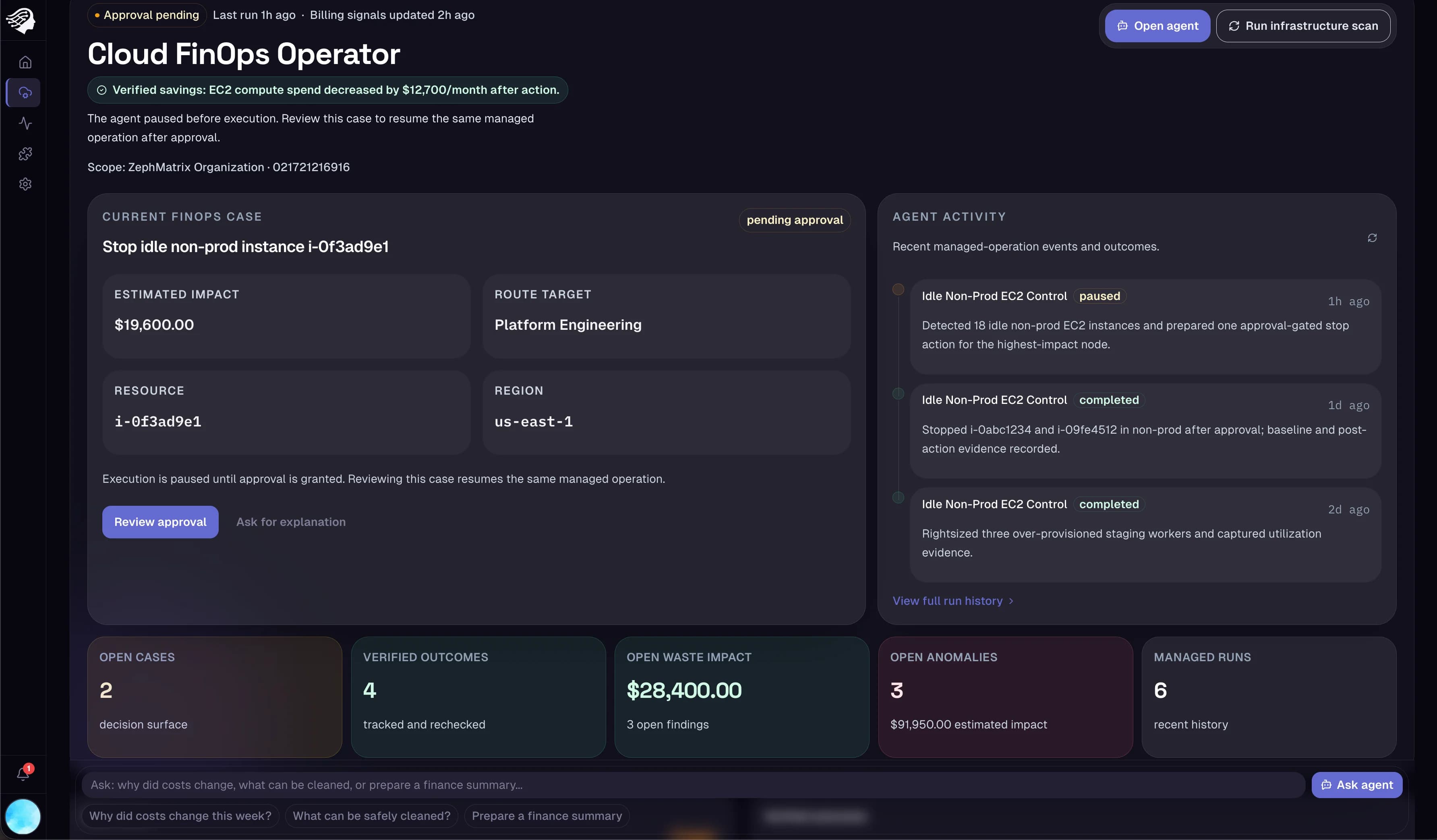
Risk‑based approvals and execution traceability are built in. High‑risk actions go through human‑in‑the‑loop review; lower‑risk ones can be auto‑approved under guardrails.

See how it works →
Time‑to‑Value

From brief to deployable in minutes

Describe the job in natural language and launch with a governed role contract, connected tools, and approval-ready execution controls.

See how it works →

Adaptive Execution

Start with revenue. Expand to every role.

Most tools stop at drafts or rigid flows. ZephMatrix teammates execute outcome-driven work with connector-aware actions, approval-aware policies, and remediation when blocked. You can start with autonomous sales execution and scale to support, operations, finance, and more.

Common workflow-tool baseline

Good for deterministic routing and repetitive handoffs, but this is not ZephMatrix's execution model.

  • Natural-language requests are often compiled into fixed workflow nodes and edges.
  • When edge cases appear, teams usually patch and redeploy the flow manually.
  • Success depends on predefining branches, conditions, and exception paths up front.
  • Lower resilience for evolving, ambiguous operational work.

ZephMatrix adaptive teammates

Built for cross-functional business execution across planning, research, operations, and compliance-sensitive work.

  • Natural-language hiring creates a strict role contract (blueprint) with specialization, scope, and guardrails.
  • Adaptive execution at runtime instead of brittle static graphs.
  • Human approvals for high-risk actions with full execution traceability.
  • Outcome-first delivery: plans, decisions, and artifacts with next actions.

Platform Capabilities

Execution surfaces built for real operations

These are live product capability surfaces across teammate execution, governance, and integrations.

Layered Memory

Ground teammates with business baseline context, conversation memory, and durable role state.

Designed for continuity across long-running work, follow-ups, and handoffs.

  • Business baseline context for grounded execution
  • Conversation continuity for follow-ups and handoffs
  • Durable role and run context across sessions

Knowledge Base

Ingest workspace knowledge from documents, website URLs, manual entries, and connected tools.

Keeps teammate execution grounded in your source material.

  • Manual notes, file uploads, and URL ingestion
  • Connected-tool ingestion via MCP integrations
  • Role-scoped retrieval during execution

Skills

Attach reusable skills so teammates follow your standard procedures and output formats.

Makes execution behavior consistent across teammates and teams.

  • Workspace skill library and pack install
  • Attach/detach skills per teammate
  • Reusable procedural patterns for repeatable outcomes

MCP Integrations

Connect external systems with MCP-compatible tools and governed role-level tool access.

Gives teammates controlled action surfaces in your existing stack.

  • MCP server registration and tool discovery
  • Role-level tool scoping and guardrails
  • Credentialed connector setup and lifecycle management

Webhooks & Triggers

Receive outbound execution events and start teammate runs from inbound trigger endpoints.

Integrates ZephMatrix runs into your operational event loop.

  • Inbound trigger endpoints for async run starts
  • Outbound webhooks for execution events
  • Delivery logging, retries, and governance controls

Artifacts

Generate downloadable outputs and keep them linked to the runs that created them.

Preserves execution provenance for review and distribution.

  • Run-linked artifact creation and download
  • Workspace artifact index and teammate-level visibility
  • Provenance metadata for traceability and review
Operational trust layer

Governance you can audit

ZephMatrix is built for verifiability, not marketing claims. Decisions, execution paths, and outputs are observable in-product with policy and approval context.

Policy-enforced approvals

High-risk actions pause for explicit human allow/deny decisions with actor identity, timestamp, and rationale.

Run-level traceability

Each run captures plan lifecycle, tool invocations, output events, and terminal outcome state for audit and review.

Artifact lineage

Generated artifacts stay linked to the originating run with context, metadata, and retrieval history.

Evidence publishing standard

Public performance metrics and testimonials are published only with validated customer approval and supporting evidence.

Governance & Security

Human approvals and full traceability, built in by default.

Every sensitive action is gated for human approval. Every execution is logged. You stay in control without being in the way.

  • Tenant-scoped data isolation controls and secure connectors
  • Field-level encryption with run trace and ledger visibility
  • Configurable guardrails enforced on every AI task
  • Human-in-the-loop approvals for guardrail-defined critical actions
Review security brief

Frequently asked questions

Practical answers on execution, control, integrations, and rollout.

What does ZephMatrix actually do?
ZephMatrix lets you hire autonomous AI teammates that execute real work. Most teams start with the Autonomous Sales Prospector to run outreach and CRM actions, then expand to support, ops, finance, and more. Every run is tracked with approvals, evidence, and full execution traceability.
How is this different from chatbots and static workflow tools?
Chatbots mostly answer, and static workflows follow predefined steps. ZephMatrix teammates execute outcomes: they plan, use tools, adapt to edge cases, and keep progressing under guardrails and approvals.
When does ZephMatrix require human approval?
High-risk actions are gated by human-in-the-loop approvals. You can allow or deny sensitive operations, and every decision is timestamped with run context for accountability.
Can teammates work with our existing tools and internal knowledge?
Yes. Teammates can use workspace knowledge and MCP-compatible integrations to retrieve context, perform actions, and produce deliverables grounded in your business environment.

More details: Pricing, Documentation, Support.